Direct answer: The frequency of an ultrasonic eyeglass cleaner is the number of acoustic cycles per second, expressed in kilohertz (kHz). Soner currently lists eyewear models at approximately 40–46 kHz, but there is no single "best" frequency for every pair of glasses. Frequency influences cavitation; lens and frame compatibility, solution, temperature, time and load determine whether a particular cleaning process is appropriate.
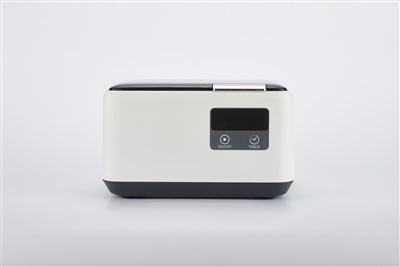
SONER SE-960 digital eyeglass cleaner. Product photographs illustrate the machine; suitability for a particular lens and frame must be checked separately.
Choosing equipment for an optical counter or eyewear program?
Compare the ultrasonic glasses cleaner range, including the SE-962 professional glasses cleaner and SE-960 digital 600 ml model. Tell us the frame and lens mix before selecting a process; send your application for review.
A model's frequency specification describes the machine. It does not certify that every assembled pair of spectacles is safe to immerse.
What does frequency change in ultrasonic cleaning?
A transducer drives pressure oscillations through the liquid. Under suitable conditions, microscopic cavities form and collapse, helping release soil from accessible surfaces such as hinges and nose-pad recesses. Changing frequency changes the acoustic field and bubble behaviour, but the cleaning result also depends on delivered power, tank geometry, liquid properties, temperature, cycle duration and how the item is suspended. A larger kHz number is not a standalone measure of cleaning quality or material safety.
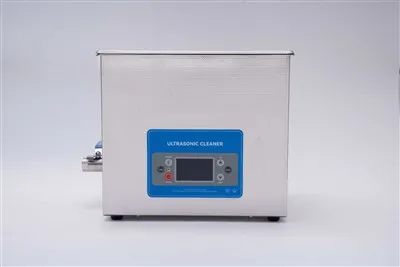
The stainless-steel tank holds the cleaning liquid. Nominal frequency alone does not establish universal lens compatibility.
Frequency is one variable in a validated process
- Machine: nominal frequency, power delivery, tank size, basket position and load.
- Liquid: water quality, approved detergent, concentration and contamination.
- Eyewear: lens material and coating, frame finish, adhesives, decorative parts and any electronics.
Is 40–46 kHz safe for coated lenses?
Do not infer lens safety from frequency alone. ZEISS's US eyewear-care guidance says ultrasonic treatment is appropriate for frames only in its recommended professional procedure: an eye-care professional removes the lenses before cleaning the frames. The lens or eyewear manufacturer's current care instruction takes priority for the specific product. If the instructions are unknown, do not promise that an assembled, coated pair can be cleaned ultrasonically.
Screen out loose coatings, cracked lenses, delaminating finishes, glued ornaments, unstable stones, water-sensitive inserts and electronic components. Where an optical professional approves a particular item and process, record the solution, load, cycle and inspection outcome. This is especially important for a retailer handling customers' mixed brands and lens treatments.
How should an optical retailer or OEM buyer compare models?
Start with the largest frame that must fit in the basket without resting on the tank bottom or touching another item. Then define throughput, operator workflow, cleaning chemistry, available power version and after-sales requirements. For an optical counter handling larger frames, review the SE-962 professional model. For a compact digital format, compare the SE-960 600 ml model; for a larger bench workflow, inspect the professional eyeglass cleaner. Confirm the current specification for the quoted variant rather than transferring one model's numbers to another.
A useful sample-acceptance test
- Select representative frame materials, finishes, hinges and removable lens assemblies; document the exclusions.
- Agree an approved solution and cycle with the eyewear or lens supplier before testing.
- Inspect before and after for residual soil, coating changes, corrosion, loose fittings and drying marks.
- Repeat at the intended load and operator cadence; record rejects and the decision rule for the next batch.
OEM buyers can also review Soner's production equipment when discussing assembly and quality-control capabilities. Ask which inspection steps apply to your exact model, market and order rather than assuming that a general factory page proves a specific batch result.
Frequently asked questions
What frequency is a Soner ultrasonic eyeglass cleaner?
Current Soner eyewear listings describe different models at about 40–46 kHz. Check the quotation and manual for the exact model and production version; the range is not a safety guarantee for every lens or frame.
Is a higher frequency always gentler on glasses?
No. Frequency changes cavitation behaviour, but coating condition, liquid chemistry, power, heat, time and loading also matter. Obtain the eyewear maker's approval before using any ultrasonic process.
Can I clean prescription glasses with the lenses installed?
Do not assume so. ZEISS's US guidance recommends professional ultrasonic cleaning of frames after the lenses have been removed. Follow the instructions for the actual eyewear being handled.
What should a distributor send for a suitable quotation?
Provide the frame and lens mix, largest dimensions, daily throughput, destination market, power version, preferred branding, sample-test criteria and service expectations.
Plan an eyewear-cleaning trial with Soner
Share representative frames, cleaning objective, expected daily volume and any lens-maker restrictions through Contact Us. We can use that brief to compare available machines and agree what needs validation before procurement.
Sources and scope
ZEISS Vision Care: care for your glasses supports the professional, frame-focused caution above. It does not validate any Soner model or a universal safe frequency.
Soner ultrasonic glasses cleaner range identifies current product options and nominal specifications. Quotation, current manual and approved sample should control model-specific claims.